


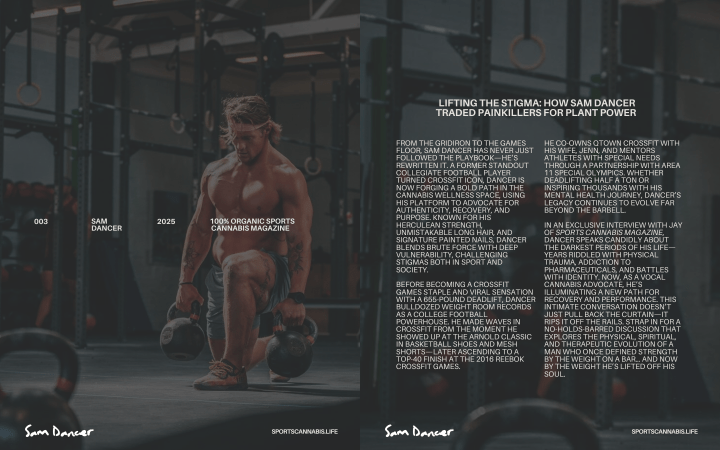
From the gridiron to the Games floor, Sam Dancer has never just followed the playbook—he’s rewritten it. A former standout collegiate football player turned CrossFit icon, Dancer is now forging a bold path in the cannabis wellness space, using his platform to advocate for authenticity, recovery, and purpose. Known for his Herculean strength, unmistakable long hair, and signature painted nails, Dancer blends brute force with deep vulnerability, challenging stigmas both in sport and society.
Before becoming a CrossFit Games staple and viral sensation with a 655-pound deadlift, Dancer bulldozed weight room records as a college football powerhouse. He made waves in CrossFit from the moment he showed up at the Arnold Classic in basketball shoes and mesh shorts—later ascending to a top-40 finish at the 2016 Reebok CrossFit Games. He co-owns QTown CrossFit with his wife, Jenn, and mentors athletes with special needs through a partnership with Area 11 Special Olympics. Whether deadlifting half a ton or inspiring thousands with his mental health journey, Dancer’s legacy continues to evolve far beyond the barbell.
In an exclusive interview with Jay of Sports Cannabis Magazine, Dancer speaks candidly about the darkest periods of his life—years riddled with physical trauma, addiction to pharmaceuticals, and battles with identity. Now, as a vocal cannabis advocate, he’s illuminating a new path for recovery and performance. This intimate conversation doesn’t just pull back the curtain—it rips it off the rails. Strap in for a no-holds-barred discussion that explores the physical, spiritual, and therapeutic evolution of a man who continues to defy odds and lift the stigma.
Jay | Sports Cannabis:
Sam Dancer in three words.
Sam Dancer:
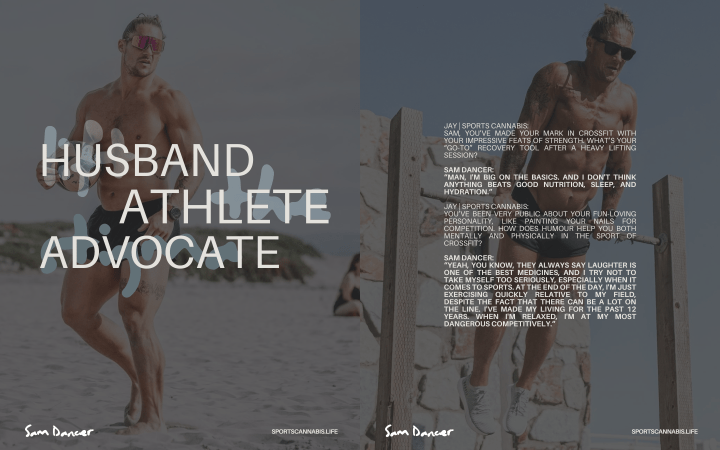
“Husband. Father. Athlete.”
Jay | Sports Cannabis:
Sam, you’ve made your mark in CrossFit with your impressive feats of strength. What’s your “go-to” recovery tool after a heavy lifting session?
Sam Dancer:
“Man, I’m big on the basics. And I don’t think anything beats good nutrition, sleep, and hydration.”
Jay | Sports Cannabis:
You’ve been very public about your fun-loving personality, like painting your nails for competition. How does humour help you both mentally and physically in the sport of CrossFit?
Sam Dancer:
“They always say laughter is one of the best medicines, and I try not to take myself too seriously, especially when it comes to sports. At the end of the day, I’m just exercising quickly relative to my field, despite the fact that there can be a lot on the line. I’ve made my living for the past 12 years. When I’m relaxed, I’m at my most dangerous competitively.”
Jay | Sports Cannabis:
Was there a time in your career when you felt like your body was completely “broken”?
Sam Dancer:
“I can go back precisely to the time. I’ve had moments in my career where my health was rapidly declining, but my mind first goes to around the age of 21. I was playing collegiate football at Western Illinois University. I didn’t have a glamorous career. I was riddled with injuries. I’m talking hundreds of concussions, broken bones, and missed a year due to an infection in my leg. I don’t think I had one healthy year in college, and I was on an abundance of pain medication, stimulants and sleeping meds. My body was an absolute mess. I struggled to even get up in the morning, not because of my emotional state, but just physically, I was so broken down that my mom would have to help me out of bed and get a bath running for me to warm my body up and get moving again.
It was just a part of that time in sports. It wasn’t unexpected for doctors to prescribe you copious amounts of drugs to cope with the damage that was done playing football. I mean, I was basically getting car crashes on a daily basis. They would send you out with bottles and bottles of pain medication. At that time, I didn’t know that I was fully aware of the ramifications of taking those medications so frequently. And may I add, I was probably I was abusing them as well, unknowingly. I wasn’t like a junkie, just trying to get drugs to numb myself. I was doing it so that I could be relatively comfortable enough to play ball. My health started to decline rapidly, gut issues and I struggled with asthma. My focus and attention were awful. I never chronically struggled with depression, but when you go through injuries, I would imagine the head trauma, too, played a role in getting down on myself. There were times when you’re like, man, what am I doing? Or how am I even going back to feeling decent enough to play? I was in really rough shape.
Jay | Sports Cannabis:
When did Cannabis enter the conversation for recovery and relief?
Sam Dancer:
I would say that right around the tail end of my collegiate career is when I started to become a little bit more interested in my well-being, holistically, from a mental, physical, spiritual standpoint and cannabis. In season, I didn’t risk getting drug tested and losing a scholarship or being unable to play or be a good teammate. It’s hard to be a good teammate when you’re suspended, and I didn’t get back into cannabis heavily until after my collegiate career.
Jay | Sports Cannabis:
What made you get back to Cannabis after your collegiate career, and how was it viewed in CrossFit?
Sam Dancer:
When I started getting into CrossFit, it was actually through some of my close relationships that sparked the conversation. They were taking a look at my lifestyle and the number of pharmaceuticals that I was taking. They’re like, “No wonder you’re struggling so much, you’re taking all these drugs, and they’re just they’re killing your health.” When they proposed cannabis, I never even really considered just putting all the pharmaceuticals down and just utilizing cannabis as a means of treatment. I was still worried about the drug-free sports issue.
I did my research, looked more closely into the drug testing policies and figured out that the testing threshold for cannabis is specific to in-competition, and I wasn’t trying to go out to the competition floor under the influence of cannabis. What I got from that was that as long as you weren’t going out on the floor under the influence, there weren’t going to be any ramifications of testing positive for cannabis because the threshold was so high. So, I did exactly kind of what my homie suggested, and I put down the pharmaceuticals and picked up the cannabis… more consistently.
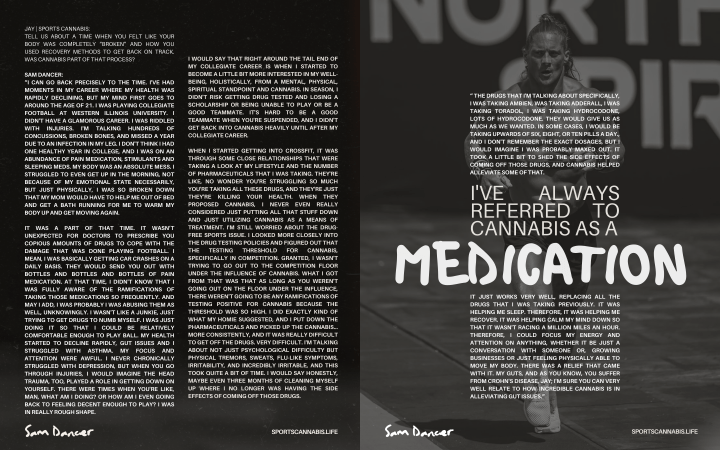
It was tough to get off the drugs. I’m talking about not just psychological difficulties but I had physical tremors, sweats, flu-like symptoms, irritability, and this took quite a bit of time to shake. I would say it took maybe even three months of cleaning myself up to where I no longer had the side effects of coming off those drugs. The drugs that I’m talking about specifically are Ambien, Adderall, Toradol, and Hydrocodone. At the time, they would give us as much as we wanted. In some cases, I would be taking upwards of eight or ten pills a day. I don’t remember the exact dosages. It took quite a bit of time to shed the side effects of coming off those drugs, and cannabis helped alleviate some of that.
Jay | Sports Cannabis:
Cannabis became your new medicine…
Sam Dancer:
I’ve always referred to cannabis as a medication. It’s worked really well with replacing all the drugs that I was taking previously. It was helping me sleep, which meant it was helping me recover, and it was helping calm my mind down so that it wasn’t racing a million miles an hour. It allowed me to focus my energy and attention on anything, whether it be just a conversation with someone or, growing businesses or just feeling physically able to move my body. There was a relief that came with cannabis…
Jay | Sports Cannabis :
How does Cannabis help you today and what is does your cannabis regimen look like?
Sam Dancer
Today, my regimen with it has changed drastically over the past 20 years. I treat it like a supplement. I treat it as part of my regimen. It’s not just like, oh, I feel like getting stoned right now. I’m gonna, yeah, I’m gonna smoke some weed. I’m very regimented with it. For instance, it will be consumed every night before I go to bed. My sleep is significantly better. I know some people don’t have the same experience with it, but it helps with my dreams a lot. I don’t dream as heavily, and when I dream heavily, I tend to toss and turn, and they’re too vivid for me.
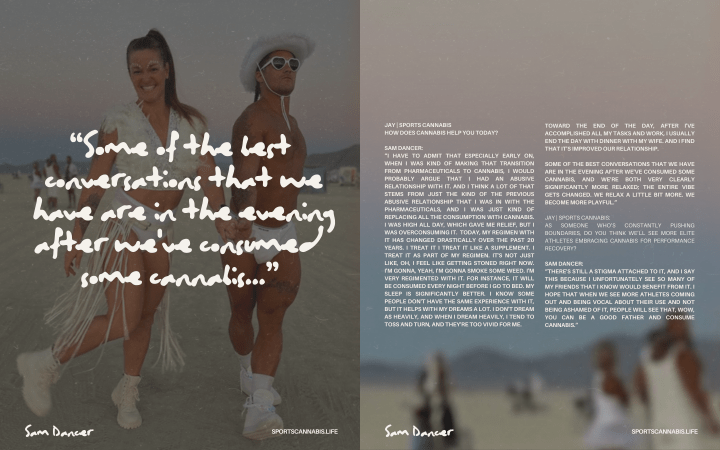
Toward the end of the day, after I’ve accomplished all my tasks and work, I usually end the day with dinner with my wife. And I find that it’s improved our relationship. Some of the best conversations that we have are in the evening after we’ve consumed some cannabis, and we’re both very clearly significantly more relaxed; the entire vibe gets changed. We relax a little bit more. We become more playful.”
Jay | Sports Cannabis:
As someone who’s constantly pushing boundaries, do you think we’ll see more elite athletes embracing cannabis for performance recovery?
Sam Dancer:
“There’s still a stigma attached to it, and I say this because I unfortunately see so many of my friends that I know would benefit from it. I hope that when we see more athletes coming out and being vocal about their use and not being ashamed of it, people will see that, wow, you can be a good father and consume cannabis.”
Toronto, Ontario
Canada
BREAKTHESTIGMA
 SPORTS CANNABIS